
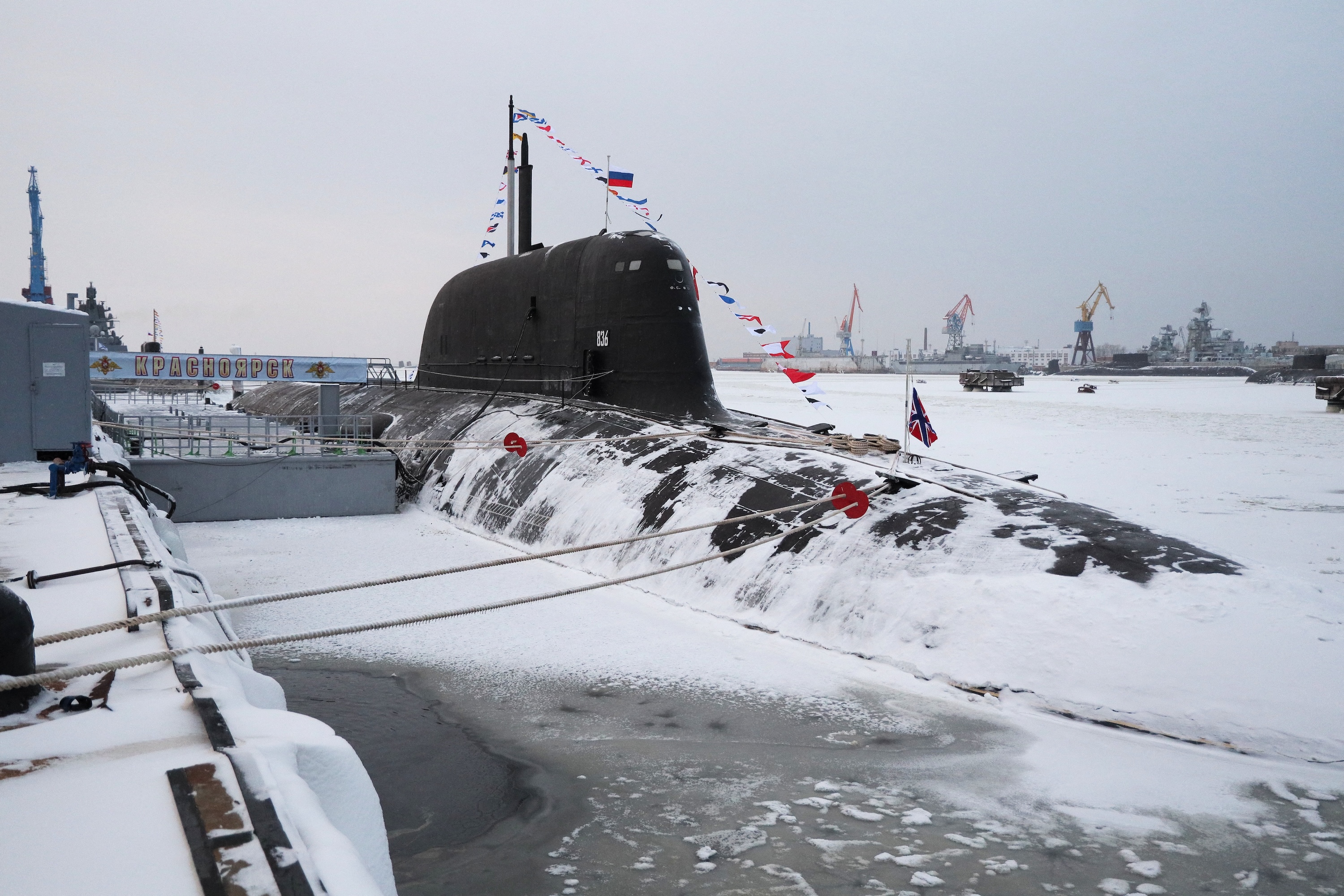
Russia’s efforts to assert its power in the Arctic are being undermined by the Ukraine war, according to U.S. intelligence.
“While Russia has enhanced its ability to operate in the Arctic by focusing on combat readiness and using dual-use technologies and facilities for defense, its war with Ukraine has limited its ability to fully achieve its Arctic ambitions,” according to the 2026 Annual Threat Assessment by the Office of the Director of National Intelligence released Wednesday.
Nonetheless, Russia still views the Arctic as vital to its security for a variety of political, economic and military reasons. “Russia has the largest Arctic coastline and views itself as part of the neighborhood,” the report noted. “Russia is our primary challenge in the Arctic as it aims to further its interests in the region as part of broader global balance-of-power competition.”
RELATED

With control of about half the Arctic coastline, Russia wants to develop the region’s oil and gas reserves, as well as benefit from more maritime trade as receding polar ice creates new shipping routes.
The Arctic is also sensitive for another reason: It is seen as a safe zone for Russia’s nuclear ballistic missile submarines.
Much of Russia’s Arctic military forces are located in the Kola Peninsula, which hosts about two-thirds of the country’s second-strike nuclear capabilities, said the report, noting that the area is home to Russia’s Northern Fleet, including seven nuclear-armed ballistic missile strategic submarines.
Russia has reinforced the Northern Fleet with long-range missiles, as well as aerial and underwater drones. The Kola Peninsula also has at least three airbases that host fighters, surveillance and transport aircraft.
Another indicator of Moscow’s Arctic ambitions is Russia’s fleet of icebreakers, which is already the world’s largest, with eight nuclear-powered and 34 diesel-electric vessels. Russian President Vladimir Putin announced in January that the first nuclear-powered Leader-class icebreaker will be launched by 2030. These 70,000-ton vessels can cut through 4.3 meters of ice, according to Russian news agency TASS.
Meanwhile, the increasing U.S. focus on the Arctic has caught the Kremlin’s attention in an area that Russia views as its backyard.
“[Russia’s] activity is aimed at countering a perceived growing U.S. emphasis on expanding its influence and presence in the Arctic as a key national security strategic objective,” the report said.
A fallen superpower, Russia wants to reshape the global balance of power. The country, viewing itself as a geostrategic competitor of the U.S., “seeks a multipolar world order in which Russia reaches and maintains a privileged position, equal to that of the U.S. and other great powers, including China,” according to the report.
As for China, it also has Arctic ambitions.
“China describes itself as a polar power and is seeking to expand its presence in the Arctic including plans to incorporate the ‘Polar Silk Road’ into its Belt and Road Initiative as shipping lanes become more accessible and economically viable,” said the report.
“Beijing seeks to expand its Arctic presence using scientific research, investments, and commercial ventures along the Northern Sea Route,” according to the report, which notes that Russia and China have conducted joint patrols in the region.
Michael Peck is a correspondent for Defense News and a columnist for the Center for European Policy Analysis. He holds an M.A. in political science from Rutgers University. Find him on X at @Mipeck1. His email is mikedefense1@gmail.com.





-3.png)