

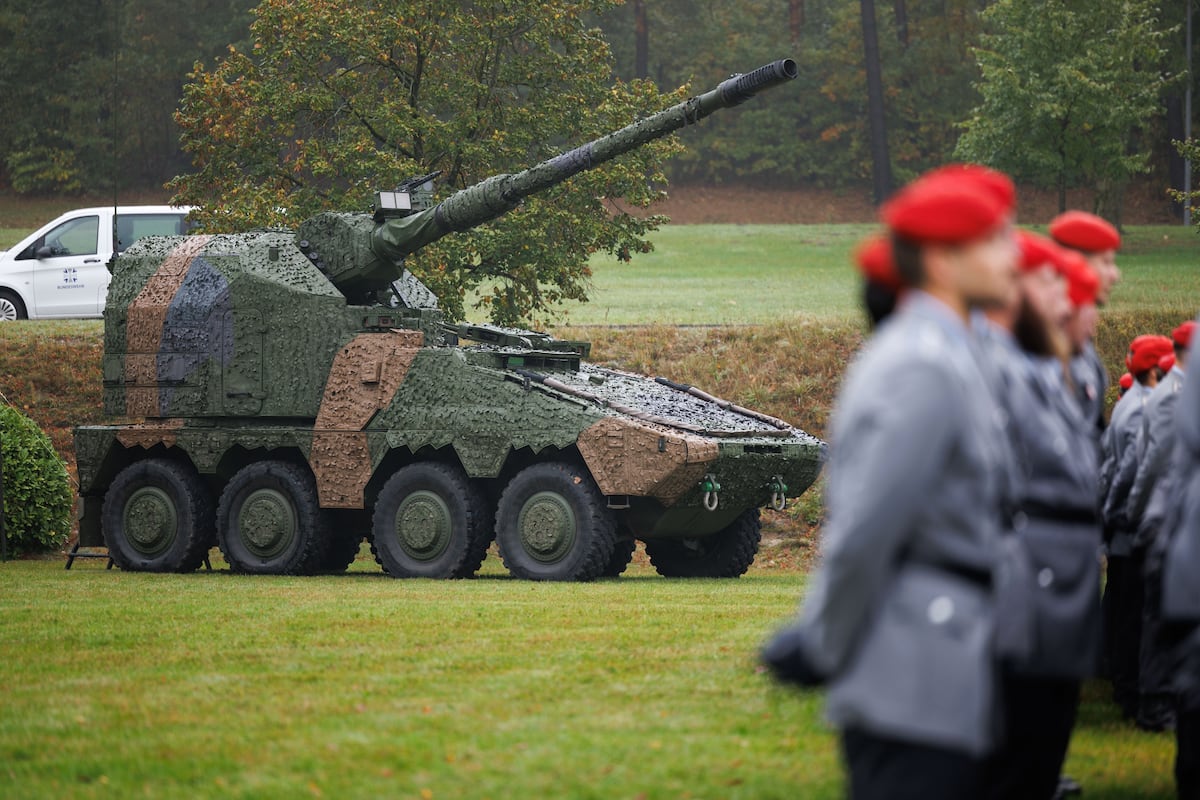
The U.S. Army faces a critical modernization crossroads in field artillery. Ukraine’s war has made viscerally clear what doctrine writers warned for years: A self-propelled howitzer that stops to fire is a vulnerable target. A towed howitzer does not have a chance. Russia’s Zoopark-1 radar can locate a firing howitzer within seconds of the first round leaving the barrel. The KNDS RCH 155 — Germany’s remote-controlled howitzer — offers a transformative answer, allowing a standard howitzer battery to fight and survive like a HIMARS battery.
The fires gap
The Army’s current self-propelled workhorse, the M109A7 Paladin, requires the crew to halt, emplace, fire and displace on a timeline measured in minutes — time that modern counter-battery systems are designed to exploit. Stryker Brigade Combat Teams face an even more acute problem: Their organic M777A2 towed howitzer cannot match the Stryker’s 60-mph road speed, and its displacement time after firing — up to 7.5 minutes with an 11-man crew — is a death sentence in a counter-battery environment. HIMARS sidesteps this problem by firing precision munitions from brief, mobile engagements, but at $150,000 per GMLRS rocket, sustained suppressive fire is prohibitively expensive. The Army needs a survivable howitzer that fills the gap between Paladin’s emplaced methodology and HIMARS’ precision strikes.
What makes the RCH 155 different
The RCH 155 is the world’s only turreted howitzer capable of firing accurately while in motion. Its unmanned Artillery Gun Module — derived from Germany’s PzH 2000 and mounted on a Boxer 8x8 chassis — uses a high-precision inertial navigation system to continuously track vehicle position and barrel orientation, firing at the computed moment of alignment. A gun crew can receive a digital fire mission, drive to a release point, fire and continue moving without ever presenting a stationary target.
Even from a static position, the numbers are stark. The RCH 155 can receive a mission, lay the gun and fire its first round in under 20 seconds. It can be back in motion in under 10 seconds after firing. KNDS comparison data tells the operational story directly: A battery of 24 M109 Paladins with 144 soldiers takes over 180 seconds to complete a 216-round fire-for-effect mission. A battery of 12 RCH 155s with 24 soldiers completes the same mission in 140 seconds — with half the systems and 83% fewer soldiers at the gun line. The RCH 155 also achieves a burst rate of nine rounds per minute versus the M109’s six, with a fully automated loading system that eliminates the need for a manual loader handling 95-pound projectiles.
Key capability advantages
Multiple Rounds Simultaneous Impact (MRSI): The RCH 155 can fire up to five rounds at different charges and elevation angles, with all projectiles arriving on target within a two-second window — replicating the concentrated effect of a HIMARS salvo at a fraction of the cost per mission.
Ammunition efficiency: By operating closer to the forward edge of the battle area without survivability risk, the RCH 155 dramatically improves accuracy. Against a 200x200m target at 7 kilometers, a conventional howitzer requires 516 rounds; the RCH 155 needs 216. At 11 kilometers, the gap is 727 rounds versus 353 — a saving of roughly 235 rounds per mission that cascades through the entire logistics chain.
Extended range: Firing V-LAP munitions, the RCH 155 reaches 54 kilometers versus the M109A7’s 40 kilometers with Excalibur. With the Vulcano guided round, range extends to 70 kilometers, approaching HIMARS GMLRS range.
Crew survivability: The Boxer chassis protects the two-man crew against 14.5mm rounds and 10-kilogram anti-tank mines. Because the Artillery Gun Module is unmanned and remotely operated, soldiers are separated from the ammunition and firing mechanism by armored vehicle structure — a survivability multiplier no current Western self-propelled howitzer offers.
A howitzer battery that fights like HIMARS
Six RCH 155s, each operating from its own hide site and receiving digitally transmitted fire missions, can coordinate MRSI timings so that all rounds arrive simultaneously. From the target’s perspective, the effect is indistinguishable from a HIMARS salvo. From the counter-battery perspective, six independently moving guns each presenting a fleeting radar return are nearly impossible to suppress — precisely how HIMARS batteries fight. Unlike HIMARS, however, the howitzer battery can sustain fires over time without exhausting an expensive rocket pod in a single volley.
Current status and US interest
The RCH 155 is not developmental — it is proven, fielded and combat-tested. Ukraine is operating 54 systems against one of the world’s most sophisticated counter-battery environments. Britain selected it as its Mobile Fires Platform in April 2024. Germany has structured its procurement framework for up to 500 vehicles, with approximately 360 slots available for allied nations at German contract pricing through a government-to-government arrangement.
The bottom line
The RCH 155 does not replace HIMARS — it complements it. HIMARS engages high-value targets at standoff with precision munitions. The RCH 155 takes over the intermediate-range fires fight: sustained suppression, preparation fires and counter-battery harassment that would drain HIMARS ammunition at ruinous cost. Together, they form a fires system that is survivable, flexible and cost-effective across the full range of brigade-level missions. The era of the emplaced howitzer battery is ending. The Army should procure the RCH 155 in sufficient numbers for the SBCT formation and evaluate for the remainder of the Army.
Bill Koziar is a retired field artillery officer who served as the military analyst for the I Corps Stryker Warfighters’ Forum. In that capacity, he developed the initial Operational Needs Statement for Stryker-borne fires capabilities, which was approved by the chief of staff of the Army. He subsequently participated in the competitive shoot-off at Yuma Proving Ground that evaluated candidate systems against that requirement. His analysis draws on direct experience shaping Army fires modernization from the ground up — from operational requirements development through live-fire evaluation.





-3.png)