

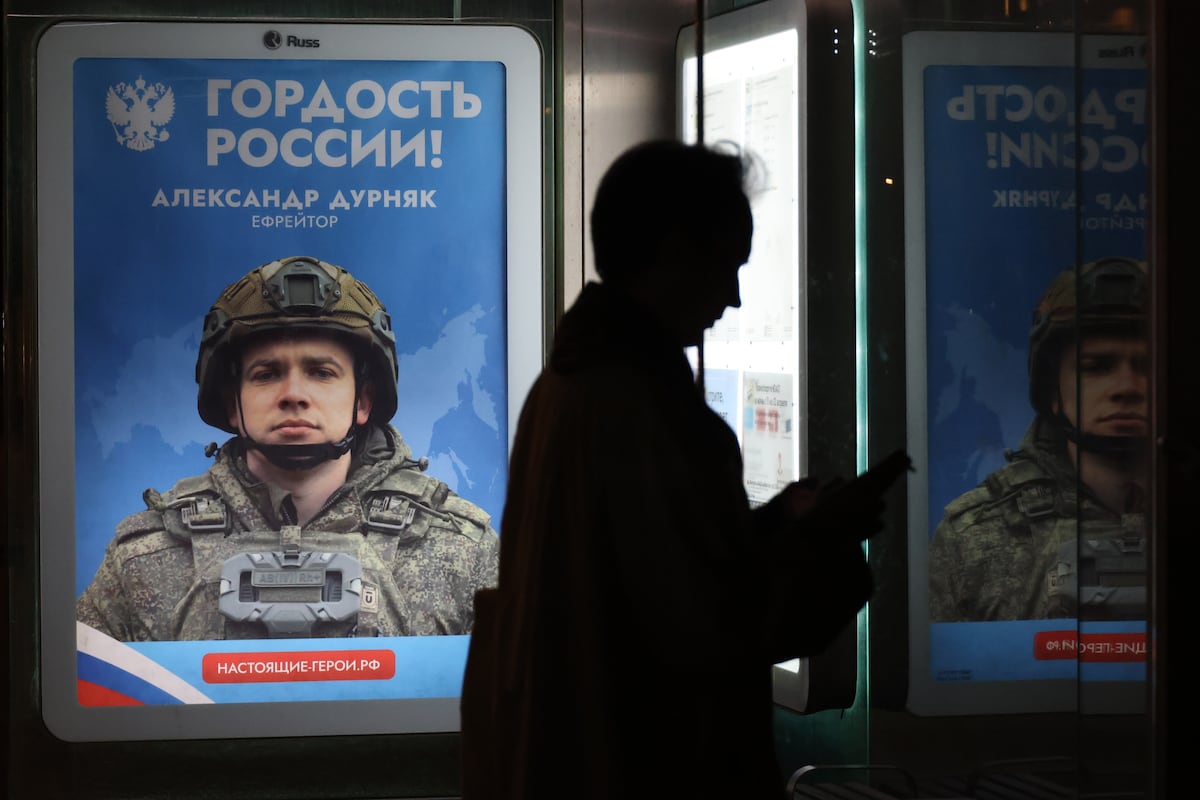
PARIS — Russia could be ready to start a regional conflict with NATO within a year after the end of hostilities in Ukraine, with the aim of creating political division in the alliance, according to Dutch military intelligence service MIVD.
Under the most favorable conditions for Russia, it could build up enough combat power for a regional challenge to NATO within a year after fighting stops in Ukraine, the MIVD wrote in its annual report. Russia’s goal would not be to defeat the alliance militarily, but to divide it through limited territorial gains, if necessary under threat of nuclear weapons use, the MIVD said.
As long as Russia is fighting in Ukraine, a conventional war against NATO is “virtually out of the question,” the Dutch intelligence service wrote in the report published on Tuesday. However, the MIVD said Russia is already making concrete preparations for a possible conflict with the alliance
“Russia poses the greatest and most direct threat to peace and stability in Europe, and thus to our national security and our interests,” MIVD Director Vice Adm. Peter Reesink said in a preamble to the report.
Western intelligence services broadly agree that Russia is actively preparing for potential conflict with NATO, though there’s less agreement on timing. Estonia’s Foreign Intelligence Service said in February it doesn’t expect Russia to militarily attack any NATO member state in the coming year, indicating the assessment will likely be similar next year as Europe bolsters its deterrence.
The war in Ukraine is part of a long-standing effort to “fundamentally alter” Europe’s security architecture, according to the MIVD. With Russia seeking a multipolar world in which it is one of the superpowers, and with liberal-democratic values posing a threat to Russia’s leadership and internal stability, the war in Ukraine takes on an existential character, it said.
Conflict-mitigating factors in place during the Cold War, such as a clear world order, arms control and structured dialogue, now appear largely absent, the report said. At the same time, the world is on the eve of a technological revolution around artificial intelligence, quantum computing and bio-science “whose consequences are not yet fully foreseeable.”
Russia’s use of methods just below the threshold of open conflict “creates a real risk of unintended and therefore difficult-to-control escalation,” the MIVD said, adding that the current unpredictable United States security policy could influence Moscow’s cost-benefit calculations.
Russia in October tested a nuclear-powered cruise missile and a nuclear-powered torpedo that will be equipped with nuclear warheads in the future, and has likely stationed the Oreshnik intermediate range ballistic missile in Belarus, according to the MIVD, which said “these weapons have an extremely destabilizing effect during crises, partly due to the extremely short warning time.”
Russia suffered about 1.2 million permanent casualties since 2022, including more than 500,000 deaths, compared to about half a million Ukrainian permanent casualties, according to the MIVD which noted a “concerning” convergence in daily combat-death ratios in 2025 that’s unfavorable to Ukraine.
Despite the losses in Ukraine, Russia still expanded its armed forces in 2025 by recruiting and training personnel, producing heavy weapon systems, and preparing strategic ammunition reserves, according to the report. The economic feasibility remains to be seen, and ongoing high material and personnel losses in Ukraine could frustrate the planned growth, it said.
“As long as the Ukrainian defense holds, the build-up of a potential Russian military threat toward NATO territory is thereby delayed,” the MIVD said.
Combat experience gained in Ukraine and the ability to integrate this into training have resulted in a “significant qualitative improvement” in the Russian armed forces, particularly in unmanned systems, according to the MIVD.
The Zapad-2025 exercise in Belarus in September showed improvements in command and control and integration of unmanned systems at all levels, and the MIVD assesses the Russian forces are “demonstrating a strong adaptive capacity.”
“The Russian armed forces have not only grown larger but have also become more effective than before the war in Ukraine,” the MIVD said.
Russia has managed to keep up large-scale weapons production despite sanctions and limited access to raw materials and components, and large-scale deployment of one-way attack drones show the country capable of maintaining “an adaptive weapons industry both quantitatively and qualitatively.”
The Russian space industry has significantly weakened due to economic sanctions and a brain drain of highly-educated technical personnel, and a lack of independently developed satellites for intelligence, surveillance and reconnaissance (ISR) means Russia “cannot fully achieve the pace required for modern warfare.”
To compensate, Russia is turning to solutions including publicly available satellite imagery, buying off-the-shelf satellites and satellite imagery from Chinese companies, and deploying alternative intelligence sensors such as unmanned aerial vehicles.
“The MIVD observes a concerning collaboration between Chinese companies and the Russian state in the field of space technology,” the report said. “This collaboration is expected to intensify further in the coming years.”
China maintains a position of “pseudo-neutrality” regarding the war in Ukraine, but in practice has “significantly intensified” military cooperation with Russia over the past year, according to the MIVD. The experience of Russian forces in Ukraine is of “great interest” to the People’s Liberation Army, which has little combat experience, the Dutch intelligence service said.
The MIVD said indications are of Chinese leadership drawing a connection between the theaters in Europe and East Asia, meaning the threat posed by China is “broadening and deepening.”
The People’s Liberation Army reorganized its cyber units in 2024, which the MIVD assesses allowed China to better integrate offensive cyber capabilities with military operations, and the country is now likely on par with the U.S. in terms of offensive cyber capabilities.
Chinese cyber espionage systemically targets the Western defense industry, according to the MIVD. The service estimates likely only a “limited portion” of Chinese cyber operations against Dutch interests are detected and mitigated.
The world is in the early stages of a new nuclear arms race, with a substantial expansion of China’s strategic nuclear arsenal, according to the intelligence services.
Weak arms control, the prospect of China as a third nuclear super power and advancing technology, “particularly the potential impact of artificial intelligence and quantum computing on nuclear decision-making processes,” create such a complicated security situation “that this arms race will be more difficult to curb than during the Cold War,” the MIVD said.
Rudy Ruitenberg is a Europe correspondent for Defense News. He started his career at Bloomberg News and has experience reporting on technology, commodity markets and politics.




-3.png)