
NEW DELHI — Amid deepening security ties between India and the U.S., New Delhi has significantly increased procurement of military equipment from Washington even as supplies from Russia, for long India’s biggest source of weapons, decline significantly.
Analysts however say that in the coming years, one of the world’s biggest arms importers is turning to countries that will give it access to critical weapons technology.
Nearly negligible a decade and a half ago, defense trade with the U.S. has jumped to $20 billion, making it New Delhi’s third-largest arms supplier after Russia and France.
In November, an Indian state-owned firm signed a $1 billion deal to buy 113 F404 engines from General Electric Aerospace to power a domestically manufactured light combat aircraft called the Tejas Mk-1A. The fighters are crucial for India’s efforts to shore up the strength of its air force in the face of neighboring China’s growing military power.
India is also in the final stages of negotiating a deal to co-produce General Electric’s F414 jet engine in the country to power a more advanced fighter jet called the Tejas Mk2 as well as initial batches of a fifth-generation fighter jet it is developing.
Those deals represent a major milestone in the India-U.S. defense relationship according to Dinakar Peri, an analyst in the Security Studies program at Carnegie Foundation.
“That is significant because for a long time, India has not bought much offensive military equipment from the U.S. except, say, Apache helicopters and howitzers. It has mostly bought support platforms,” he pointed out. “But now over the next 15 to 20 years, an estimated 350 to 400 fighter jets that will be made in India will have American engines at the heart of the planes. That is almost 40 to 50 percent of the sanctioned fighter strength of the Indian Air Force.”
While India is building fighter jets for its air force, New Delhi lacks the know-how to make engines to power the aircraft.
In November, Washington also approved arms sales of Javelin anti-tank missiles and Excalibur precision artillery projectiles to New Delhi worth $92.8 million. India will also lease two additional MQ-9B Sea Guardian predator drones for the Indian Navy, to expand maritime surveillance across the Indian Ocean.
The defense deals came amid tensions that persisted for months over 50% tariffs that Washington had imposed on Indian goods – the highest in the world – until a trade deal reached this week slashed the duties. Analysts say security ties have remained insulated from the friction over trade.
“In the turbulent first year of Trump 2.0, if there has been continuity in the relationship, that has been in defense. Both countries are persevering with the security partnership such as military exercises and signing new contracts for weapons,” according to Brigadier Arun Sahgal, who directs the Forum for Strategic Initiatives here.
“In fact defense is the only silver lining in the relationship and will provide the necessary accelerator to maintain balance in the relationship,” he said.
The defense partnership is driven by Washington and New Delhi’s need to balance China’s rising power in Asia. While approving the supply of anti-tank missiles and artillery projectiles, the Pentagon’s Defense Security Cooperation Agency said that the sales would strengthen its strategic relationship with India, which it called “an important force for political stability, peace, and economic progress” in the Indo-Pacific and South Asia.
In recent years, India’s procurement of military equipment from the U.S. has included Apache helicopters, Super Hercules transport planes and maritime patrol aircraft.
But as India pushes to modernize its armed forces, it is accelerating efforts to increase defense production at home and upgrade its military capabilities to counter regional rival China. The so-called “Make in India” and “Self-reliance” drive has gathered urgency amid recent hostilities with Pakistan and China — Indian and Chinese troops were engaged in a four-year-long military standoff following a border skirmish in 2020. A four-day conflict between India and Pakistan last May was their worst in decades.
India’s most ambitious indigenous defense project is developing a fifth-generation fighter aircraft. While initial batches will be powered with the American F414 engines, New Delhi has turned to France to gain access to crucial technology. A deal is in the final stages of approval to co-develop and co-produce engines for the aircraft with full technology transfer.
“We are about to start engine manufacturing work in India with the French company Safran,” Indian Defense Minister Rajnath Singh said in August.
New Delhi is also leaning toward a French fighter jet to equip its air force. The Defence Procurement Board, which evaluates defense equipment acquisitions, recently approved a proposal to buy 114 Rafale jets from France’s Dassault Aviation. While more approvals will be needed, analysts say the deal is in the final stages. India has previously bought 36 Rafales.
“France provides the alternative as India seeks strategic autonomy. New Delhi does not want too much dependency on the U.S., especially amid the current geopolitical uncertainties,” pointed out analyst Peri.
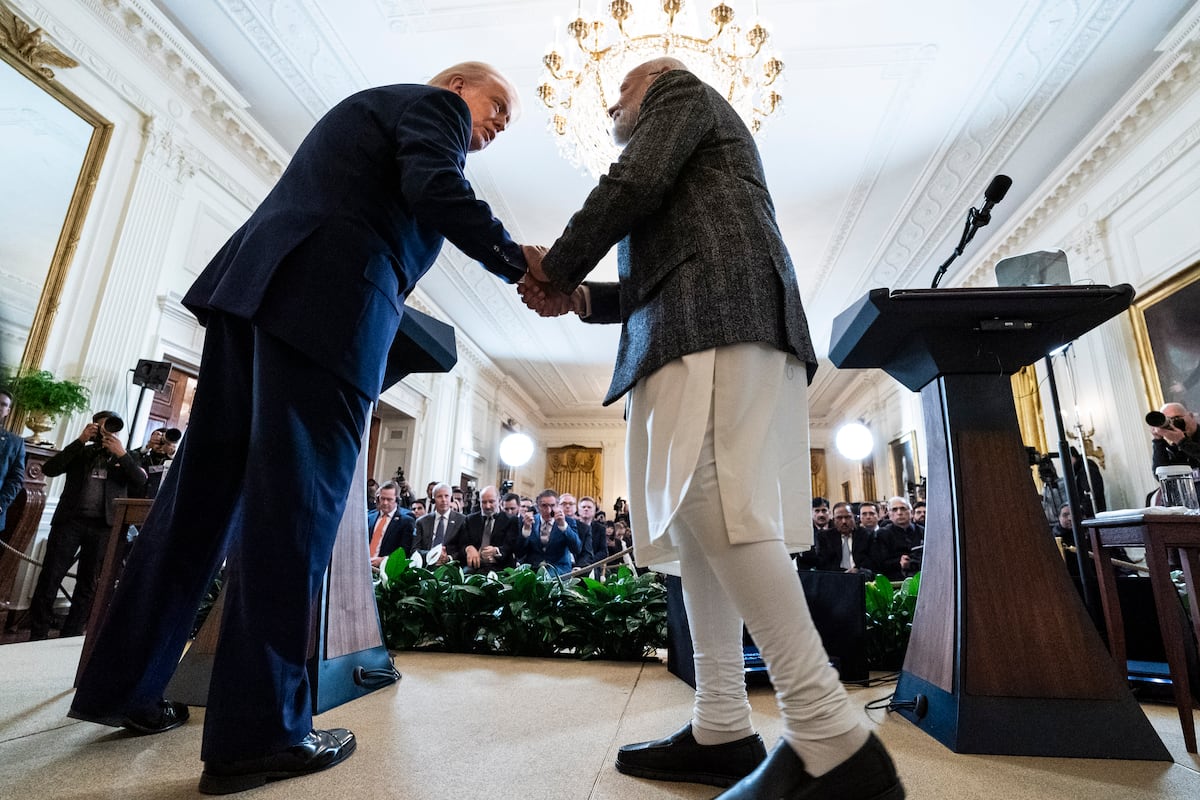
During a meeting last February between Indian Prime Minister Narendra Modi and President Donald Trump, the American president said that the U.S. is paving the way to ultimately provide India with the F-35 stealth fighters.
But analysts in New Delhi rule out the possibility of India opting for the F-35, pointing out that stringent controls attached to U.S. military equipment are a deterrent in buying advanced equipment from Washington.
“With fighter jets the problem is the conditions attached to their sale. Modern military hardware for example requires a constant software upgrade. All this gives the U.S. leverage in control over the equipment, which India would not want,” according to Manoj Joshi, distinguished fellow at New Delhi’s Observer Research Foundation.
He says India’s caution has redoubled amid the global turbulence witnessed in the past year. “We were getting friendlier towards American imports but there will be a rethink. Yesterday the U.S. was New Delhi’s close friend, today it is no longer a friend to the same extent, what tomorrow holds we don’t know,” said Joshi.
Although India has diversified its purchases away from Russia, it is still a top weapons supplier – partly because Indian military systems continue to require Moscow’s support, and partly because it is willing to supply advanced systems and share technology with New Delhi, with which it shares a close partnership.
As New Delhi spends billions of dollars to strengthen its defense in the coming years, India will turn to countries that are willing to share technology and produce military equipment in the country. Part of the production of Rafale fighter jets, for example, is expected to take place in India, once the deal gets the green signal.
Analysts say it remains to be seen if similar deals can be struck with the United States.
“India will continue to maintain the pace of its defense relationship with Washington, but to sustain it beyond a certain point, it has to move beyond being purely transactional and move into the realm of joint production and joint development of weapons,” according to Sahgal.




-3.png)