
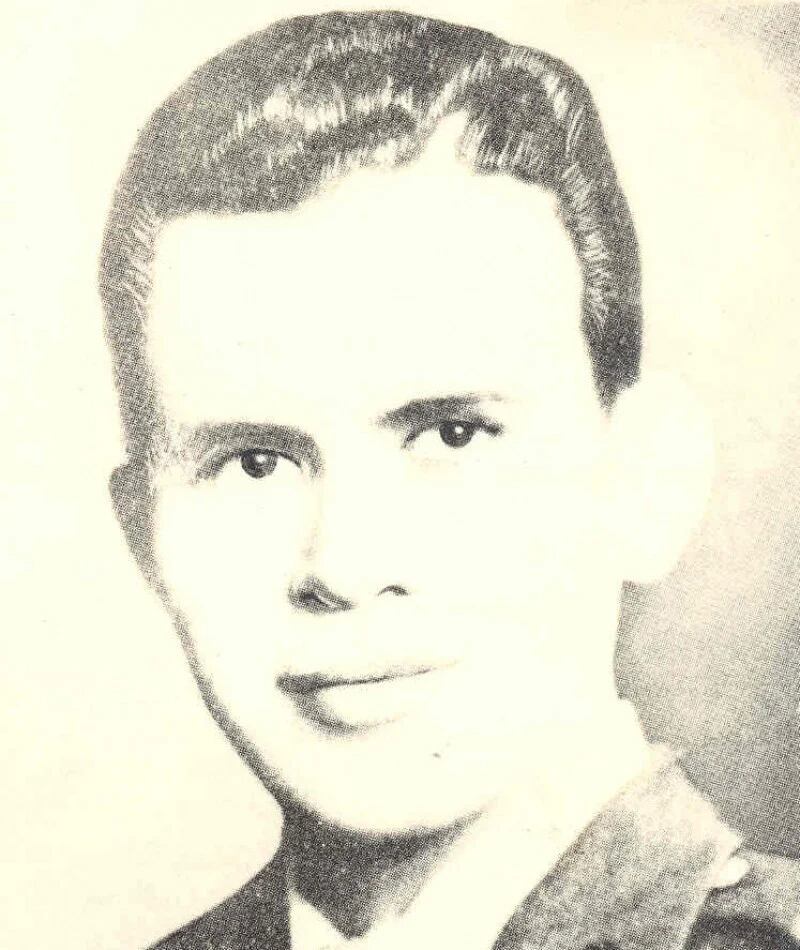
Airborne troops are extremely vulnerable when they are descending in their parachutes. To compensate, their intense combat training is designed to take charge from the moment their boots touch the ground... whatever that ground may be. One of the many cases in point is that of PFC. Manuel Pérez Jr.
Born in Oklahoma City, Oklahoma, on March 3, 1923, Pérez was raised in Chicago, Illinois, after the death of his mother, Tiburcia, when he was just two years old. After graduating high school, the young Pérez worked at a time for Best Foods Inc., but in January 1943 he enlisted and, since he had not been drafted, he could choose his branch of service. For Pérez, that choice was airborne training and attachment to Company A, 511th Parachute Infantry Regiment — dubbed the “Angels” and “The Band of Brothers of the Pacific” — 11th Airborne Division.
During training at Camp Toccoa, Georgia, Pérez acquired the nickname of “Toots” from his fellow troopers for his youthful looks. He was also described as soft spoken and intense by nature, but his poor marksmanship scores at Camp Mackall, North Carolina almost led to his transfer. With help from his friends, however, he overcame his handicap enough to pass.
Regarding one of his demonstrated special talents, his platoon commander, 2nd Lt. Theodore Baughn, remarked: “His detection of the enemy was very sharp. And his reaction with weapons was very quick and effective.”
Consequently, by the time the 511th arrived at its frontline assignment, southern Luzon, Pérez was the lead scout for A Company.
On Feb. 3, 1945, the 511th PIR parachuted onto Tagaytay Ridge as part of Operation Shoestring, a series of maneuvers to slip past Japanese forces holding the Philippine capital of Manila.
The 11th Airborne Division was attached to the Sixth Army, engaged in a race against time to liberate the city before its fanatical defender, Rear Adm. Sanji Iwabuchi, destroyed it along with its populace.
It may be noted that the Japanese army commander-in-chief on Luzon, Gen. Tomoyuki Yamashita, had evacuated most of his force out of the city and into the mountains in order to maintain a mobile presence for as long as possible. He had ordered Iwabuchi to do the same, but the admiral disobeyed and ignored that order. As a result, an estimated 100,000 civilians were murdered before Manila could be liberated.
On Feb. 13, the objective for Company A was Fort William McKinley (renamed Andrés Bonifacio in 1949). The fortifications included a dozen concrete pillboxes, which Pérez was the first to encounter. Eliminating them one by one was a task that seemed tougher with each advance. Pérez managed to clear the first 10, but encountered resistance in the 11th — with the private engaging and killing five Japanese in the open before moving up toward the last emplacement.
The defenses of the 12th included two twin-mount .50-caliber machine guns and this was enough to stop the paratroops in its tracks... until Pérez decided to take matters into his own hands, as described in his citation, Pérez,
“took a circuitous route to within 20 yards of the position, killing four of the enemy in his advance. He threw a grenade into the pillbox, and, as the crew started withdrawing through a tunnel just to the rear of the emplacement, shot and killed four before exhausting his clip. He had reloaded and killed four more when an escaping Jap threw his rifle with fixed bayonet at him. In warding off this thrust, his own rifle was knocked to the ground. Seizing the Jap rifle, he continued firing, killing two more of the enemy. He rushed the remaining Japanese, killed three of them with the butt of the rifle, and entered the pillbox, where he bayoneted the one surviving hostile soldier. Singlehandedly, he killed 18 of the enemy in neutralizing the position that had held up the advance of his entire company.”
The 511th PIR resumed its advance to clear Manila and into the hinterlands, with Pérez usually the vanguard. On March 14, however, as A Company was making its way toward Santo Tomas, the 22-year-old was shot in the chest by a sniper and died shortly afterward.
On Dec. 27, Pérez was posthumously awarded the Medal of Honor, as well as a Bronze star and Purple Heart. His father had returned to Nuevo Laredo, Mexico, by then, and the medal’s presentation to Manuel Sr. had to be arranged at the International Bridge on Feb. 22, 1946. Pérez’s remains, however, were interred in the Fairlawn Cemetery in his hometown of Oklahoma City. His name lives on in Little Village Square School in Chicago and the Manuel Perez Jr. Reserve Center in Oklahoma City.



-3.png)